What to write in a custom song: 40 memory prompts
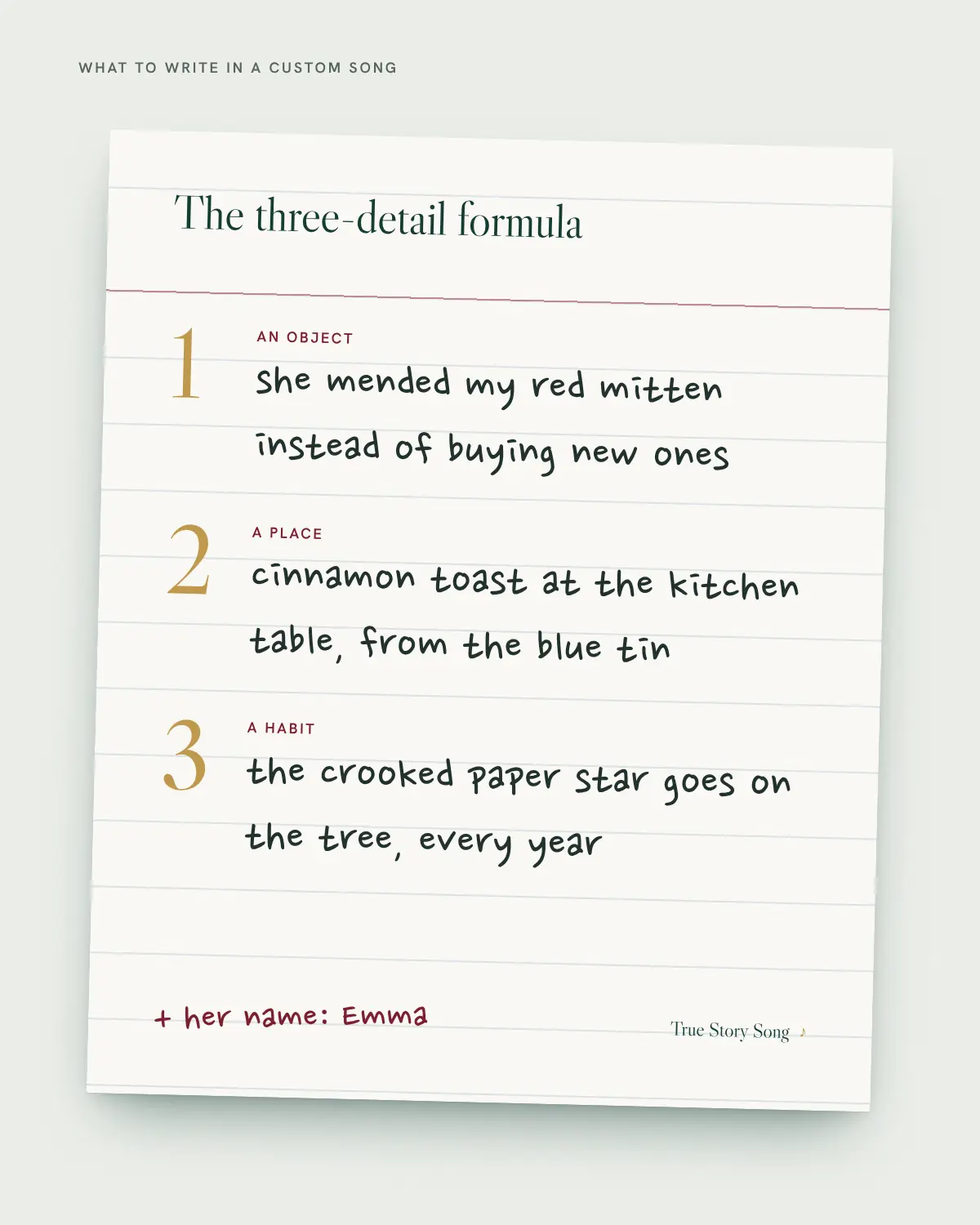
Write three small, true details: one object they'd recognize, one place you shared, and one habit only they have. Add their name and how to say it. Skip big words like "amazing" or "always there for me". Specific details make a song sound like your family; general praise makes it sound like anyone's.
The three-detail formula
Most personalized songs fail the same way: the lyrics could be about anyone. The fix isn't more words. It's better nouns.
- An object. Something you could hold: a chipped mug, a red mitten, a bent bicycle wheel.
- A place. Somewhere you were together: the coastal road, the kitchen at 6 a.m., the bench by the water.
- A habit. Something they do without thinking: humming while cooking, folding napkins into triangles, drawing maps by hand.
Three is enough. A song has room for about three images before the chorus repeats. More than that, and the best details get squeezed out.
Vague vs. specific: what changes
The first version gives a songwriter, human or AI, nothing to picture. The second gives three images that can each become a line.
A real example, from memories to lyrics
This is one of the examples on our home page: a daughter's three memories of her mom, Emma. The names and memories are fictional; the audio is real AI output.
- She mended my red mitten instead of buying new ones.
- Cinnamon toast, kept warm in a blue tin.
- The crooked paper star still goes on the tree.
And here are lines from the song that came out:
A red wool mitten on the table
A little tear I thought would grow
Cinnamon toast beneath a folded napkin
Emma, there is home in what you do
A thousand little kindnesses I carry through
Your crooked paper star still lights my heart
Notice that every line points to a real thing. Nothing in it says "best mom ever", and yet it's clearly about one specific mother. Listen to the full sample.
40 memory prompts, by relationship
Pick one prompt from each group that sparks a real picture. You don't need to answer all of them.
For Mom
- What did she make when you were sick?
- What does she say every time you leave?
- Which object of hers would you keep forever?
- Where did she sit in the kitchen?
- What did she fix instead of replacing?
- What song did she sing badly and happily?
- What's on her fridge right now?
For Dad
- What did he teach you with his hands?
- What's in his car that's always there?
- Which Saturday routine was his?
- What's his one joke he still tells?
- Where did he take you when you needed to talk?
- What did he build, draw or repair for you?
- What does he call you that no one else does?
For your wife or husband
- Where were you when you knew?
- What do they do while the pasta boils?
- Which mug, jacket or blanket is "theirs"?
- What wrong turn turned into a good day?
- What small thing do they do every morning?
- What's your shared joke in two words?
- What sound means they're home?
For kids
- What's their favorite stuffed animal called?
- What word do they say wrong in a cute way?
- What's the bedtime ritual?
- Where do they always want to go?
- What did they make you that's still on display?
- What makes them laugh the hardest?
For grandparents
- What smell means their house?
- What did they keep in a tin or a drawer?
- Which story do they tell every holiday?
- What game did they always let you win?
- Where did they grow up, and what did they miss about it?
- What did they give you that you still use?
For a best friend
- Where did you meet, exactly?
- What's the trip you still talk about?
- What do they order every single time?
- What did they do on your worst day?
- What's the inside joke that needs no explaining?
- What will you still be doing together at 80?
- What's their signature text message?
How to make sure the name sounds right
- Spell it the way it sounds in a separate pronunciation note: "Siobhan = shi-VAWN", "Joaquín = wah-KEEN".
- Mark the stress with capitals: "a-NEE-ka", not "AN-i-ka".
- Use the name they're called, not the one on their passport. "Grandpa Joe" beats "Joseph".
- Short names sing more easily. If the full name is long, a nickname in the chorus often works better.
What to leave out
- Private details you wouldn't want played at a family dinner: health, money, arguments.
- Other people's full names, unless they'll be happy to hear them in a song.
- Lists of adjectives. "Kind, funny, strong, beautiful" becomes filler in a song.
- Lyrics from songs you love. They belong to their writers. Describe the feeling instead.
- Memorials, written carefully. For someone who has passed, choose gentle, happy details and say so in your notes, so the song comforts rather than surprises.
Questions about writing custom song lyrics
How long should my notes be?
About one sentence per memory. Three good sentences give better lyrics than a page of general praise.
Can I write the lyrics myself?
Our free song lyrics generator is coming soon.
What if I can't think of any memories?
Look around their home in your mind: the fridge, the car, the coat hook, the kitchen table. Objects bring the memories back.